Shop
Shop
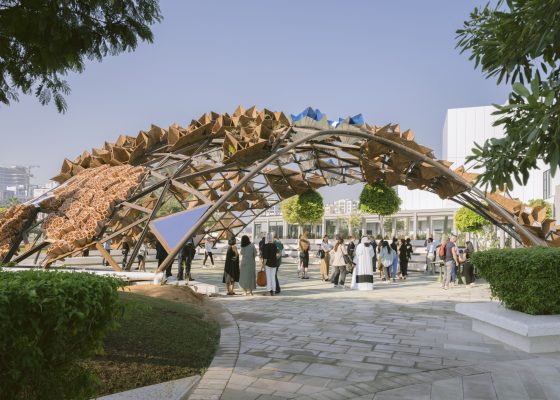
‘Tarabot: Weaving a Living Forum’ is a large-scale domed pavilion commissioned by Art Jameel for the Jameel Art Centre’s adjacent sculpture park as part of COP28 in 2023. It was conceived as an interspecies structure designed to support both human and interspecies use by providing shading and cooling via the integration of traditional systems as well as incubating flora throughout the structure to support insect and bird habitats. Over time these systems presented challenges regarding upkeep and the attraction of birds, insects and other species in the park.
Tarabot has a predetermined afterlife: its steel frame is destined for submersion in the Gulf of Oman, off the coast of Fujairah as substrate for coral reef rehabilitation. Prior to this taking place, this Global Summer School workshop uses the structure’s final terrestrial weeks as a site for research and intervention.
Over two weeks, a small cohort of students will conduct a systematic forensic audit of Tarabot’s success based on its original intention, design a precise architectural correction, and fabricate a 1:1 prototype to be inserted directly into the dome’s steel framework.
- Days 1 to 3 | Forensic Audit & Analysis: Conduct an environmental and behavioural reading of Tarabot using various physical computing sensors to identify the component needing critical attention and intervention.
- Days 4 to 7 | Design Development & Fabrication Drawings: Launch a design charrette using computational tools to turn data into a precise architectural brief and fabrication-ready drawings.
- Days 8 to 9 | Fabrication & Installation: Move from off-site workshop fabrication to on-site assembly, installing full-scale prototype directly into Tarabot’s steel framework.
- Days 10 to 12 | Documentation & Exhibition: Curate drawings, datasets, and audiovisual archive for a public presentation at Jameel Arts Centre.
Programme mentors:
Nader Akoum is a Lebanese architect and IAAC graduate in Advanced Architecture and 3D-printed earthen architecture, currently pursuing a Master of Science in Applied Artificial Intelligence. He is the founder and Director of Studio Madane, a studio based between Beirut and Barcelona building ventures at the intersection of tech, urbanism, culture, and sociopolitical transformation. His work integrates process architecture, change management, and multiscalar engagement across Lebanon, Spain, Saudi Arabia, and wider regional collaborations in the EuroMed.
Karine Baidoun is a Lebanese architectural designer with nearly 7 years of experience contributing to large-scale international projects across multiple phases of design development. Her work spans construction documentation, architectural drawing production, BIM coordination, fabrication detailing, and advanced 3D modeling. She operates fluently across industry-standard architectural software and technical workflows. Over the years, she has developed a particular focus on façade systems, especially metallic envelope assemblies.
Zahra Mansoor is an exhibition designer at Art Jameel, where she delivers exhibitions, commissions and public programmes; translating curatorial concepts into spatial, technical and material outcomes. Trained in architecture, her practice spans research, sculpture and film, examining how bodies and built environments are shaped by time, migration and social expectation. She works with clay, wax and found materials, making change tangible through transformation, erosion and reuse. She co-founded Another Empty House, a recognised project on vacant domestic houses in Kerala and Gulf migration.
Adithya Suresh is an emerging multimedia designer, and a graduate of the Dubai Institute of Design and Innovation. His research sits between product design, systems thinking, prototyping, and material exploration, with a focus on understanding how people, objects, and environments interact. Physical computing is central to Adithya’s work, and his thesis was a multidisciplinary study that explored how design can be a problem-framing tool for observation and transformation, translating complex conditions into tangible products and systems that include sound, touch, and experience.
In partnership with IAAC Global Summer School 2026 and Studio Madane.
Dates
6 – 17 July 2026
Location
Jameel Arts Centre, Jaddaf Waterfront, Dubai Creek
Fee
AED 2,800, inclusive of all materials. Travel, accommodation, and food are not included.
Places
Limited to 12 participants, allocated on a first-come, first-served basis.
Eligibility
Open to practitioners and students from architecture, urbanism, digital fabrication, design, and art. No prior specialist knowledge is required. A working knowledge of English is essential. Participants must bring their own computer with design software installed.
Certificate
Participants will receive an IAAC Global Summer School Certificate upon completion.
Visa
Participants traveling from outside the UAE are responsible for their own visa arrangements. Jameel Arts Centre and IAAC will provide a confirmation letter of participation and will assist the process wherever possible.
Places are strictly limited to 12 participants. Applications are allocated on a strictly first-come, first-served basis.
SEE ALL EVENTS