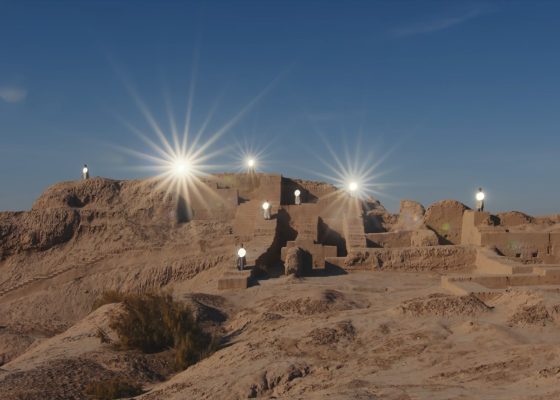
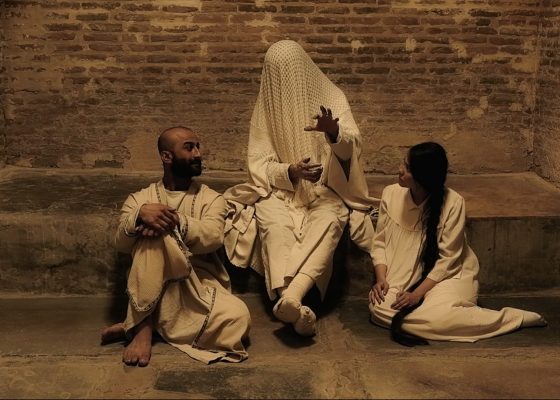
In Driant Zeneli’s trilogy, ‘The Animals. Once Upon a Time … in a present Time’ (2019 – 2022), buildings and stories reappear in the present, intertwining architecture and fable.
The three films take place in three Brutalist buildings in the Balkans: the National Library of Kosovo in Prishtina, the Pyramid of Tirana, Albania, and the Central Post Office in Skopje, North Macedonia.
The works reflect the persistent instability of the Balkans, the transitory condition of its architectures and the fragility of utopia. Brutalist structures—hallmarks of socialist architecture in the region, built to imagine new societies under authoritarian regimes—become portals between the mythic world of folktales, where animal creatures are protagonists, and the human world, where the built environment, though seemingly fixed, continually shifts with time and the bodies that inhabit it.
No wise fish would escape without flying (2019)
Courtesy of the artist
The film tells the story of a fish fleeing a shark that gets trapped in a net in the National Library of Kosovo. Realised in collaboration with young team members of Bonevet, a non-profit institution in Prishtina that considers technology a method to learn science, understand life, and increase imagination, Zeneli asks the children to help release the fish from the net and outrun the shark. The film is a witness to this composition, in which the Brutalist architecture of the library transforms into a landscape, and the fish transforms into a bird as it escapes.
Located at the centre of the University Campus in Pristina, the National Library of Kosovo, designed by Andrija Mutnjaković and completed in 1981, has undergone multiple transformations since the 1970s—renamed several times, used as a Serbian Orthodox religious school and occupied by the Yugoslav Army during the NATO bombings, when over 100,000 books were stolen or destroyed—and today remains open to the public with most of its 600,000 volumes preserved.
How deep can a Dragonfly swim under the ocean? (2021)
Courtesy of the artist
The second chapter follows a dragonfly that can move its wings, yet is doomed never to fly, leaving it unable to escape the ocean. The dragonfly moves inside the Pyramid of Tirana, a late-1980s memorial to the Albanian dictator Enver Hoxha. Built in 1988 as a monument to the regime, the structure has undergone multiple transformations since the fall of communism—serving at various moments as a museum, discotheque, bar and cultural venue—mirroring Albania’s turbulent political and social transitions. Within the monument’s brutalist arch
The dragonfly—a symbol of spiritual depth, power, transformation and adaptation—recalls the experience of Rilond Risto, who, unjustly, spent 21 years in Albanian prisons and, during his final years of isolation, built mechanical insects capable of flight from improvised materials.
The Firefly keeps falling and the Snake keeps growing (2022)
Courtesy of the artist and Fondazione In Between Art Film
The film draws on a medieval fable about a snake attempting to devour a firefly simply because it shines too brightly, placing this allegory of fragile brilliance alongside the symbolic failure and material abandonment of the Skopje Central Post Office, one of the most emblematic Brutalist structures in the Balkans. Built in 1974 as part of the reconstruction of Skopje following the devastating 1963 Skopje earthquake, which led to the city being largely rebuilt through modernist and Brutalist architecture, the building was designed by Macedonian architect Janko Konstantinov, whose vision drew on organic, almost extraterrestrial forms that evoke a cosmic, biomorphic landscape. Severely damaged by a fire in 2013, the structure now stands partially ruined and abandoned, and is today listed among Europe’s seven most endangered heritage sites.
This film was conceived and created with the students of the Ss. Cyril and Methodius University in Skopje, North Macedonia. Over the course of a year, they jointly built the film’s two mechanical protagonists—the firefly and the snake—and brought the original tale to a different conclusion: although the firefly is eaten, this time it burns the snake from within its belly.
About the artist
Driant Zeneli (b. 1983, Shkoder, Albania) lives between Tirana and Turin. In 2019 and 2011, he represented the Albanian Pavilion at the 58th (solo show) and 54th (group show) International Art Exhibition – Venice Biennale.
About the film programme
How to Reappear presents a series of films that explore what it means to be remade, to survive and to persist in altered forms. The works draw viewers into intimate encounters with transition and transformation, revealing the intensity and tenderness of these processes as well as their moments of shock and disorientation. In these stories, flesh, terrains and topographies become sites where transformation unfolds. They underscore the fragility of bodies and landscapes as myth, illusion and virtuality shape how change is imagined and endured. To explore the film programme, click here.
SEE ALL EVENTS
 Shop
Shop