 Shop
Shop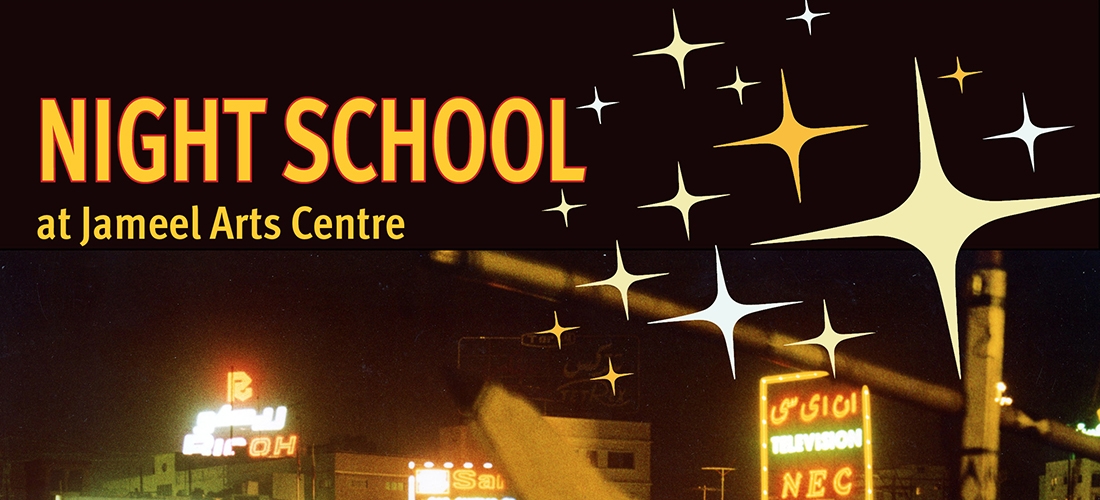
The first edition of the Night School programme coincided with the Off Centre / On Stage exhibition at Jameel Arts Centre, curated by architect and writer Todd Reisz.
A small seminar group of 15 Dubai residents met regularly for three weeks in January 2022 to explore the ways Dubai has been shaped by architecture and design and the people who transformed the design into reality. The six seminar meetings offered the chance to engage with important texts about regional urbanism and engage with some of the leading scholars on the topics. The invited speakers and guests elaborated on Dubai’s growth and ambitions in relation to other cities in the Gulf.
Night School 2022 guests included: author and researcher Rana AlMutawa, historian and author Rosie Bsheer, historian and author Nelida Fuccaro, urbanist and author Alamira Reem Al Hashimi, researcher Sultan Sooud Al Qassemi and design researcher Asseel Al-Ragam. Film curator Hind Mezaina facilitated film screening events.
—
Rana AlMutawa is an Assistant Professor of Social Research and Public Policy at New York University Abu Dhabi. She focuses on urban ethnography; social hierarchies (race, class, gender, citizenship; Orientalism; social distinction); and belonging. Rana completed her doctoral training at the University of Oxford in 2021 and published her first book, Everyday Life in the Spectacular City: Making Home in Dubai, in 2024 with the University of California Press. Prior to being at Oxford, Rana worked as an instructor and researcher at Zayed University in Dubai. As an Emirati woman, she was interested in and wrote about questions on state feminism, national identity and ethnic diversity among Emiratis. She has published her work in Arab Studies Journal (2020); Hawwa (2020); Urban Anthropology (2019); New Middle Eastern Studies (2016) and in other public platforms such as the LSE Middle East Studies Blog where she wrote about navigating multiple lived experiences in the Gulf, social distinction and perceptions of authenticity.
Rosie Bsheer is Associate Professor of History at Harvard University, where she teaches graduate and undergraduate courses on oil and empire, social and intellectual movements, urban history, historiography, and the making of the modern Middle East. Rosie’s publications include Archive Wars: The Politics of History in Saudi Arabia (Stanford University Press, 2020) and “A Counterrevolutionary State: Popular Movements and the Making of Saudi Arabia,” Past and Present (2018). She is a board member of the journal Comparative Studies of South Asia, Africa and the Middle East (CSSAME), Associate Producer of the 2007 Oscar-nominated film My Country, My Country, and a co-editor of Jadaliyya E-zine. Rosie received her Ph.D. in History from Columbia University (2014) and joined Harvard after Yale University, where she taught for four years.
Nelida Fuccaro is a historian and Professor of modern Middle Eastern history at the New York University Abu Dhabi. Professor Fuccaro specialises in the history of the modern Middle East with a focus on the Arab World, particularly Iraq, the Arab States of the Persian Gulf, the Arabian Peninsula and Kurdistan. Although a regional specialist, she has a keen interest in cross-regional and inter-disciplinary approaches to the study of urban history, oil societies and cultures, public violence, and historical borderlands. She is the author of The Other Kurds: Yazidis in Colonial Iraq (IB Tauris 1999), Histories of City and State in the Persian Gulf: Manama since 1800 (Cambridge University Press 2009); co-editor of Urban Violence in the Middle East: Changing Cityscapes in the Transition from Empire to Nation State (Berghahn, 2015); editor of Histories of Oil and Urban Modernity in the Middle East (thematic issue in Comparative Studies of South Asia, Africa and the Middle East, 2013) and Violence and the City in the Modern Middle East (Stanford University Press, 2016). She has also published articles on port cities, colonial knowledge, ethnicity, and nationalism.
Alamira Reem Al Hashimi (BA Arch; MPL; PhD) is an urbanist, architect and historian. She is the first Emirati woman to be awarded a PhD in urban planning (obtained from the University of California Berkeley) and is considered one of the leading researchers on the urban development of the United Arab Emirates. Dr. Alamira Reem is actively engaged in government initiatives related to strategy and master planning, documentation and preservation of the built environment, knowledge development and outreach, and has over 15 years of local and international experience in urban planning and design. She has authored several publications, including Planning Abu Dhabi: An Urban History, a book that explores and documents Abu Dhabi’s urban development.
Sheikh Sultan Sooud Al-Qassemi is a columnist and researcher on social, political and cultural affairs in the Arab Gulf states. He is also the Founder of the Barjeel Art Foundation in Sharjah, UAE. Sheikh Sultan was an MIT Media Lab Director’s Fellow from 2014 to 2016, a practitioner-in-residence at the Hagop Kevorkian Center for Near Eastern Studies at New York University in Spring 2017 and a Yale Greenberg World Fellow in 2018. He was a visiting instructor at the Council of Middle East Studies at Yale University, the Center of Contemporary Arab Studies at Georgetown University, the American University of Paris, the Islamic Civilization and Societies program at Boston College, the School of Public Affairs at SciencesPo Paris, the Middle East Initiative at the Harvard Kennedy School, the School of Arts and Sciences at Brandeis University, the School of International and Public Affairs at Columbia University, New York, and most recently at Bard College Berlin. Sheikh Sultan, along with Todd Reisz, is co-editor of Building Sharjah (Birkhäuser, 2021).
Asseel Al-Ragam is an Associate Professor and the Vice Dean for Academic Affairs, Research and Graduate Studies at the College of Architecture at Kuwait University. She is also the coordinator of the master’s program at the College, where she teaches modern architectural history and research, criticism and advanced design studio. Her research focuses on urban and architectural development and housing and public space in Kuwait – drawing links between these fields and the broader debate on socio-cultural modernity and political engagement. She is the author of the award-winning paper Denial of Coevalness: Discursive Practices in the Representations of Kuwaiti Urban Modernity. She was previously a visiting researcher and guest lecturer at the École nationale supérieure d’architecture Paris-Malaquais, Paris, France. Currently, she is an architecture and urban planning consultant at the Technical Advisory Committee for Architecture and Urban Planning at the Private University Council in Kuwait.
Hind Mezaina is an artist, writer and film curator from Dubai. Working primarily in analogue photography and more recently in video, her practice delves into themes of collective memory, the notion of heritage, and depictions of the UAE in the media. Mezaina is also the founder of The Culturist blog; Moving Image Editor at Tribe, a non-profit publication and platform that focuses on photography and moving image from the Arab World; and the co-founder of Tea with Culture podcast. She has curated film screenings for local institutions, including Louvre Abu Dhabi, Manarat Al Saadiyat, Sharjah Art Foundation, The Africa Institute, Alliance Française Dubai and Jameel Arts Centre.