 Shop
Shop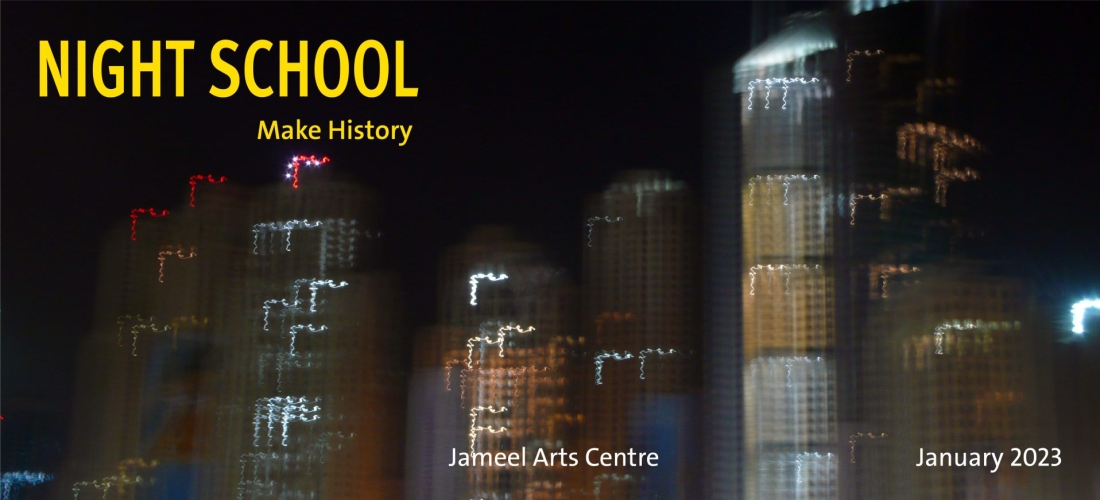
In Dubai, you witness history being made. It happens most emphatically across the landscape, in the construction of towers, ports, roadways and bridges. You could say that builders, architects, engineers, and planners are hired to write that history. And the work requires creative engagement with both the past and the future.
At Night School this year, we will encounter assembled skylines alongside other ways that history gets made: filed inside halls of institutions, resurfaced during a garage renovation, concealed in the ground below, or sprouting from the landscape around us. Gathered in a city that arises through its connections to the world, we will examine how the evidence of Dubai’s history streams through places nearby and far.
Themed ‘Make History’, Night School 2023 invited local and international scholars and the seminar participants to explore how history gets written, and constructed, in Dubai and the greater region.
Night School 2023 guests included: historian and author Rosie Bsheer, librarian and researcher David Hirsch, researcher and author Hasan H. Karrar and architect Suha Hasan. Film curator Hind Mezaina facilitated film screening events.
Night School 2023 hosted two events that were open to the general public, to collectively engage and reflect on the programme themes.
January 9, 2023 | Making History: Archives, Museums, Cities – A lecture by Rosie Bsheer
The production of history is premised on the selective erasure of certain pasts and the artefacts that stand witness to them. In this talk, Rosie Bsheer dwelled on the practices and politics of history-making by exploring the relationship between archives, museums, the built environment and structures of power.
January 14, 2023 | Make History: Filed and Concealed – Film Screening curated by Hind Mezaina
The screening featured five short films made by artists and filmmakers about the control and (in)visibility of archives and libraries. The screening was followed by a discussion between Hind Mezaina and Todd Reisz, with audience participation. The following films were screened:
- Memorial for the Lost Pages (Madiha Aijaz, Pakistan, 2018, 3 min, courtesy of Uneza Aijaz)
- These Silences Are All the Words (Madiha Aijaz, Pakistan, 2018, 15 min, courtesy of Uneza Aijaz)
- How to Reverse a Spell: The Promise of an Archive (Yasmine Benabdallah, Morocco, 2022, 10 min, courtesy of the artist)
- A History of the World According to Getty Images (Richard Misek, Norway/UK, 2022, 19 min, courtesy of the artist)
- Time Capsule (Jan Ijäs, Finland, 2016, 21 min, courtesy of the artist and AV-arkki)
—
Rosie Bsheer is Associate Professor of History at Harvard University, where she teaches graduate and undergraduate courses on oil and empire, social and intellectual movements, urban history, historiography, and the making of the modern Middle East. Rosie’s publications include Archive Wars: The Politics of History in Saudi Arabia (Stanford University Press, 2020) and “A Counterrevolutionary State: Popular Movements and the Making of Saudi Arabia,” Past and Present (2018). She is a board member of the journal Comparative Studies of South Asia, Africa and the Middle East (CSSAME), Associate Producer of the 2007 Oscar-nominated film My Country, My Country, and a co-editor of Jadaliyya E-zine. Rosie received her Ph.D. in History from Columbia University (2014) and joined Harvard after Yale University, where she taught for four years.
David Hirsch was the advisor for the Mohammad bin Rashid Library in Al Jaddaf, Dubai. Hirsch was previously a Special Coordinator at UAE University’s Zayed Central Library and a Chief Librarian and then Libraries Advisor at the Abu Dhabi National Library from 2009-2011. Hirsch also served as the Librarian for Middle Eastern, Central Asian, South Asian and Islamic Studies at the University of California-Los Angeles (UCLA) from 1989 to 2008. He holds the title of Distinguished Librarian and was named Librarian of the Year at UCLA in 2013.
Hasan Karrar is Associate Professor at LUMS specialising in Chinese, Central Asian and Twentieth century international history. He was a visiting scholar at the Asian Institute, Munk Centre for International Studies, University of Toronto. His research and writing focuses on bazaars and markets in Central Asia and China’s border regions, inquiring what these ubiquitous public spaces reveal about the economies and political structures in which they operate. He has also published widely on transnational connections and geopolitical alignments between China, Central Asia and north Pakistan that register variously in local histories and affects, multilateral initiatives, and curated Silk Road imaginaries. Hasan is the co-lead of the British Academy global convening programme Chinese Global Orders, a member of the editorial board of Asian Anthropology, and serves on the advisory board of the International Quarterly of Asian Studies, and the academic committee of the Asian Borderlands Research Network.
Suha Hasan is the founder of ASH, an architecture practice based in Stockholm. Her research explores obscure histories, material conditions and environmental impacts connected to the built environment, specifically archaeological and heritage sites. She has lectured and taught in universities in Bahrain, Egypt, Singapore, Sweden, Sudan and the UK. She is the founder of Mawane, a platform for urban research based in Bahrain and a founding member of the MSc (Modern Sudan collective). Both platforms enable research and the sharing of its outcomes through public art exhibitions, talks and workshops. She is also the head of the AA Visiting School Khartoum and has served as a consultant for UNDP Sudan. Her current research investigates the agency of architecture and archives in the formation of memory in the post-colonial city. Hasan curated two cultural seasons at Mawane: [In]Accessible, explored the privatisation of public spaces, and [Media]tions, explored issues related to memory and archives. Her publications include A Room of One’s Nation and Buildings of Independence (archithese 4, 2022). She was also the research editor for the award-winning publication Places of Production, which accompanied the national pavilion of Bahrain at the Venice Biennale (2016). She earned a PhD from KTH Royal Institute of Technology, Stockholm.
Hind Mezaina is an artist, writer and film curator from Dubai. Working primarily in analogue photography and more recently in video, her practice delves into themes of collective memory, the notion of heritage, and depictions of the UAE in the media. Mezaina is also the founder of The Culturist blog; Moving Image Editor at Tribe, a non-profit publication and platform that focuses on photography and moving image from the Arab World; and the co-founder of Tea with Culture podcast. She has curated film screenings for local institutions, including Louvre Abu Dhabi, Manarat Al Saadiyat, Sharjah Art Foundation, The Africa Institute, Alliance Française Dubai and Jameel Arts Centre.